Information
Landmark: Chania Old Venetian HarborCity: Crete
Country: Greece
Continent: Europe
Chania Old Venetian Harbor, Crete, Greece, Europe
The Old Venetian Harbor of Chania is a historic maritime district in Chania, Crete. Built by the Venetians between 1320 and 1356, it served as a major commercial port and defensive stronghold. Today, it is an architectural landmark characterized by a blend of Venetian, Ottoman, and Egyptian influences.
Visual Characteristics
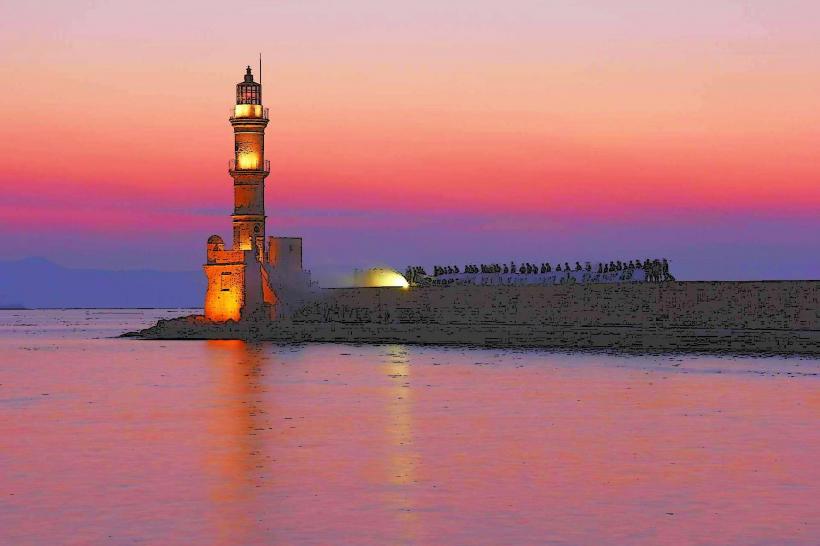
The harbor is defined by a long, curved promenade lined with pastel-colored Venetian buildings featuring wooden shutters and red-tiled roofs. The dominant feature is the Lighthouse of Chania, situated at the end of a stone sea mole. The waterfront area is densely packed with outdoor seating for restaurants and cafes, set against the backdrop of the Cretan Sea.
Location & Access Logistics
Position: Northern edge of Chania Old Town.
Access: Pedestrianized waterfront. The interior alleys of the Old Town are a labyrinth of narrow footpaths.
Transit: Accessible via the central bus station (KTEL) of Chania, followed by a 10-minute walk through the Old Town.
Vehicle Access: No vehicles allowed on the harbor front. Large public parking lots are located at the edges of the historic district (e.g., Talos Square or the East Moat).
Historical & Ecological Origin
The Venetians constructed the harbor to support their Eastern Mediterranean trade routes and to protect Chania from naval attacks. In the 17th century, the Ottomans modified many structures, notably converting churches into mosques (such as the Mosque of the Janissaries). In the 19th century, during Egyptian rule, the lighthouse was rebuilt in its current minaret-like form.
Key Highlights & Activities
Chania Lighthouse: A 16th-century structure modified in 1839. While the interior is closed, the walk along the sea mole to its base is a primary activity.
Firka Venetian Fortress: Located at the western entrance; it houses the Maritime Museum of Crete and offers panoramic harbor views.
Mosque of the Janissaries (Giali Tzamisi): The oldest Ottoman building in Crete (1645), recognizable by its large dome. It now serves as an exhibition space.
Venetian Arsenals (Neoria): Large 16th-century vaulted stone structures originally used for ship repair.
Moro Shipyard: Houses a permanent exhibition of ancient shipbuilding, including a reconstructed Minoan ship.
Infrastructure & Amenities
Facilities: High density of tavernas, boutiques, and street vendors.
Connectivity: 5G signal is stable throughout the harbor.
Terrain: Level stone pavement on the promenade, but the sea mole to the lighthouse is uneven and lacks safety railings.
Public Services: Restrooms are available in cafes and a public facility near the Arsenals.
Best Time to Visit
07:00–09:00: Optimal for sunrise photography and to avoid the mid-day heat and large tour groups.
Sunset: The harbor is oriented such that the sun sets directly into the sea, illuminating the Venetian facades.
Evening: The area reaches peak density after 21:00 as a central nightlife hub.
Facts & Legends
A verified historical fact is that the harbor basin is relatively shallow (approx. 2.5 meters), which eventually led to its decline as a commercial port when modern steamships required deeper berths. Local lore suggests the labyrinthine streets surrounding the harbor were designed to trap intruders in dead-ends, a common Venetian defensive urban strategy.
Nearby Landmarks
Maritime Museum of Crete: 0.1km West
Old Town (Splantzia District): 0.3km East
Municipal Market of Chania (Agora): 0.6km South
Chania Lighthouse: 0.5km (via the sea mole)