Information
Landmark: Arco della Pace (Arch of Peace)City: Milan
Country: Italy
Continent: Europe
Arco della Pace (Arch of Peace), Milan, Italy, Europe
The Arco della Pace-or Arch of Peace-stands proudly at the northern edge of Milan’s Parco Sempione, just beyond the Sforza Castle, marking one of the city’s grandest neoclassical landmarks. With its elegant sculptures, detailed bas-reliefs, and commanding symmetry, it tells a story of ambition, war, peace, and Milan’s place in European history.
Historical Background
The monument’s origins date to the Napoleonic era. Construction began in 1807 under Luigi Cagnola, commissioned by Napoleon Bonaparte as part of a grand entranceway into Milan from Paris. It was intended to celebrate Napoleon’s victories and mark the beginning of the Strada del Sempione, the imperial road connecting Milan with the French capital through the Alps.
When Napoleon fell from power in 1814, work on the arch was halted. Later, under Austrian rule, the Habsburgs resumed construction and redefined its meaning. It was no longer a monument to Napoleonic glory but a symbol of European peace following the Congress of Vienna (1815). The arch was completed in 1838 and officially inaugurated in the presence of Emperor Ferdinand I of Austria.
Architectural and Artistic Design
Built of Baveno granite and Crevola marble, the Arco della Pace stands about 25 meters high and 24 meters wide-a majestic gateway inspired by ancient Roman triumphal arches but softened by neoclassical grace.
Cagnola’s design features a central archway flanked by two smaller side arches, framed by Corinthian columns and richly carved entablatures. The entire surface is adorned with reliefs and sculptures that narrate the intertwined history of Milan, Italy, and Europe.
Notable details include:
Bas-reliefs depicting historical scenes such as the Peace of 1815, the Battle of Leipzig, and allegorical figures representing rivers, virtues, and victories.
Statues of classical deities-including Mars, Minerva, and Apollo-symbolizing strength, wisdom, and harmony.
The Quadriga della Pace (Chariot of Peace), a magnificent bronze sculpture crowning the top of the arch. It features the goddess of Peace driving a six-horse chariot, flanked by equestrian statues of messengers of victory.
Every surface of the monument is carefully proportioned, combining Roman grandeur with Italian artistry. The sculptural program was executed by several Lombard masters, including Pompeo Marchesi and Luigi Acquisti, adding local refinement to its imperial vision.
Location and Urban Setting
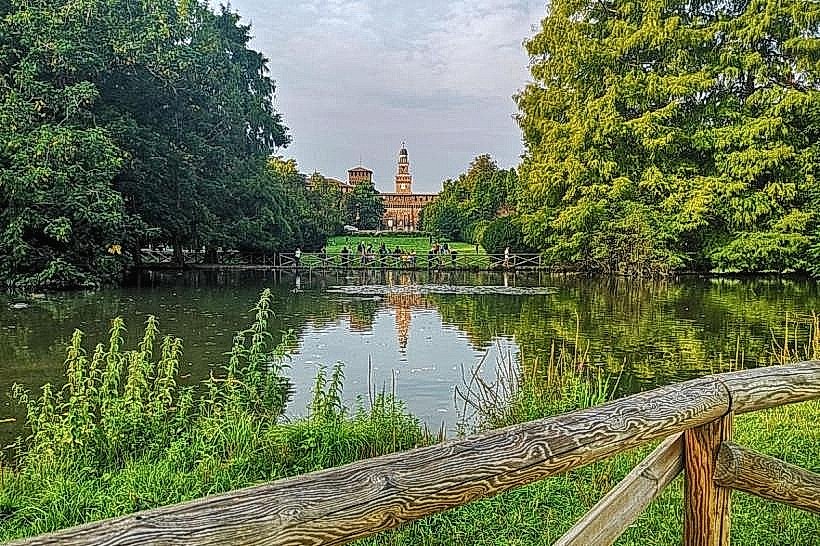
The arch stands on Piazza Sempione, directly aligned with the Arco del Sempione axis that leads through Parco Sempione to Castello Sforzesco, forming one of Milan’s most beautiful visual corridors. In the 19th century, this axis was symbolic of the city’s gateway to Europe.
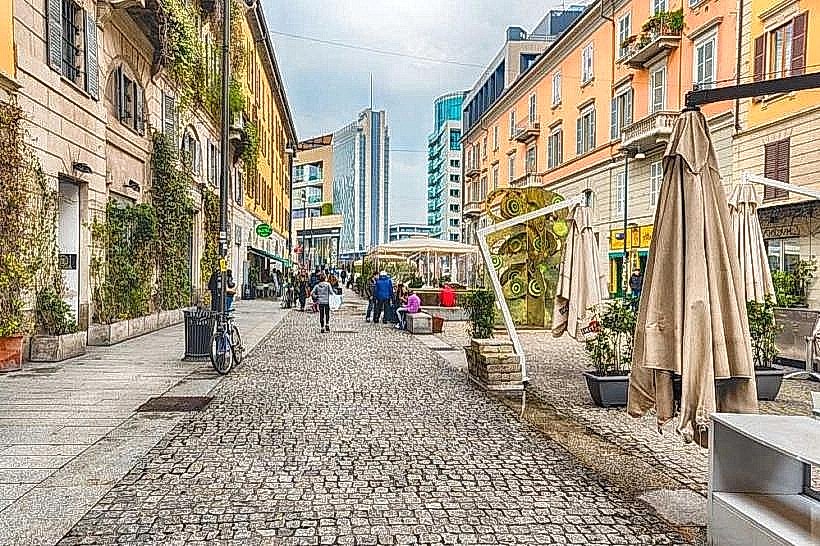
Today, the area is both elegant and relaxed. Locals gather around the square on weekends, and the arch serves as a backdrop for open-air concerts, cultural events, and evening strolls. The surrounding streets are filled with lively cafés, small restaurants, and boutique shops-especially along Corso Sempione, one of Milan’s most popular avenues.
At sunset, the marble takes on a warm golden hue, and the silhouettes of the bronze horses gleam against the fading sky-a timeless sight that balances majesty and serenity.
Symbolism and Legacy
Throughout its history, the Arco della Pace has shifted in meaning-from Napoleonic triumph to Austrian diplomacy, and later, to Italian unity. After the unification of Italy in 1861, it became a patriotic monument, symbolizing the nation’s rebirth and Milan’s vital role in it.
During the 20th century, it stood witness to Italy’s tumultuous political changes and later became a symbol of peace and civic pride. Unlike Rome’s ancient arches, Milan’s version looks forward, not backward-a neoclassical ideal of progress and concord.
Modern Presence
Today, the Arco della Pace remains one of Milan’s most photogenic and atmospheric spots. It’s not just a relic of empire but a living space-surrounded by greenery, laughter, and the rhythm of modern city life. Standing beneath its columns, one feels the scale of history meeting the pulse of present-day Milan: elegant, cosmopolitan, and forever reinventing itself.