Information
Landmark: Piazza Gae AulentiCity: Milan
Country: Italy
Continent: Europe
Piazza Gae Aulenti, Milan, Italy, Europe
Piazza Gae Aulenti is the gleaming symbol of contemporary Milan-a circular, elevated plaza that embodies the city’s transformation into a global capital of modern architecture and urban innovation. Located in the Porta Nuova District, just north of the historic center, this dynamic square represents the new face of Milan: vertical, sustainable, and forward-looking, yet still deeply tied to its human scale and cultural roots.
Origins and Development
The piazza was inaugurated in 2012 as part of the massive Porta Nuova redevelopment project, which reimagined a former industrial zone into one of Europe’s most advanced urban districts. The project unified three previously disconnected areas-Garibaldi, Varesine, and Isola-creating a continuous flow of architecture, green spaces, and public art.
Named after Gae Aulenti, the celebrated Italian architect and designer best known for transforming Paris’s Musée d’Orsay and Barcelona’s Palau Nacional, the square pays homage to her visionary work in redefining modern public spaces.
Designed by Argentine architect César Pelli, who also created the surrounding UniCredit Tower complex, Piazza Gae Aulenti serves as both the heart and the symbol of this new Milanese skyline.
Architectural Design
The piazza sits on a raised circular platform about six meters above street level, seamlessly connecting pedestrian paths and terraces. Its circular layout-spanning roughly 80 meters in diameter-creates a sense of unity and openness amid the towering glass buildings that surround it.
The materials-steel, stone, and glass-reflect Milan’s contemporary aesthetic of restrained elegance. The pavement, made of dark slate, mirrors the sky and the vertical reflections of the skyscrapers, while embedded LED lights illuminate the plaza at night in soft, futuristic tones.
At its center lies an interactive fountain and water feature, whose jets rise and fall rhythmically to ambient sounds and music. Around it, wooden benches, glass balustrades, and minimalist landscaping invite visitors to pause and observe the interplay between architecture, people, and light.
Surrounding Landmarks and Skyline
Piazza Gae Aulenti anchors a cluster of architectural landmarks that define Milan’s modern skyline:
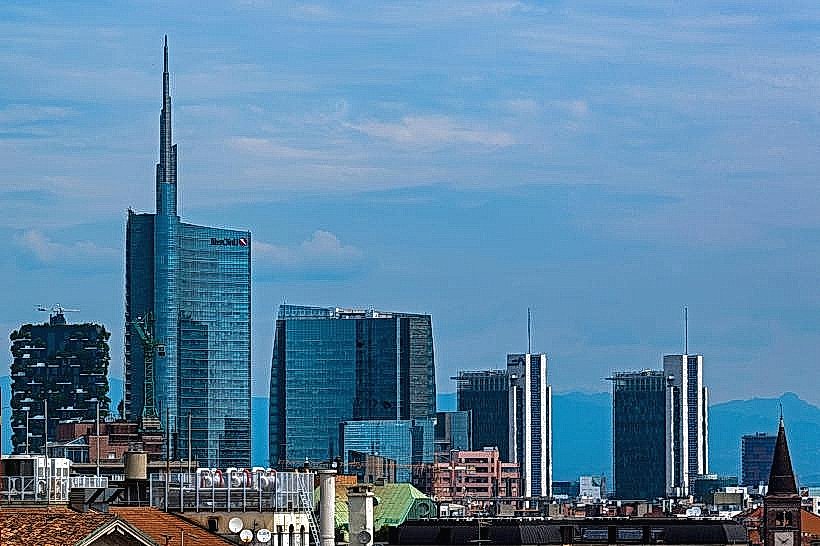
UniCredit Tower – At 231 meters, Italy’s tallest building. Its curved glass façade and spiraling spire dominate the view, symbolizing Milan’s economic vitality.
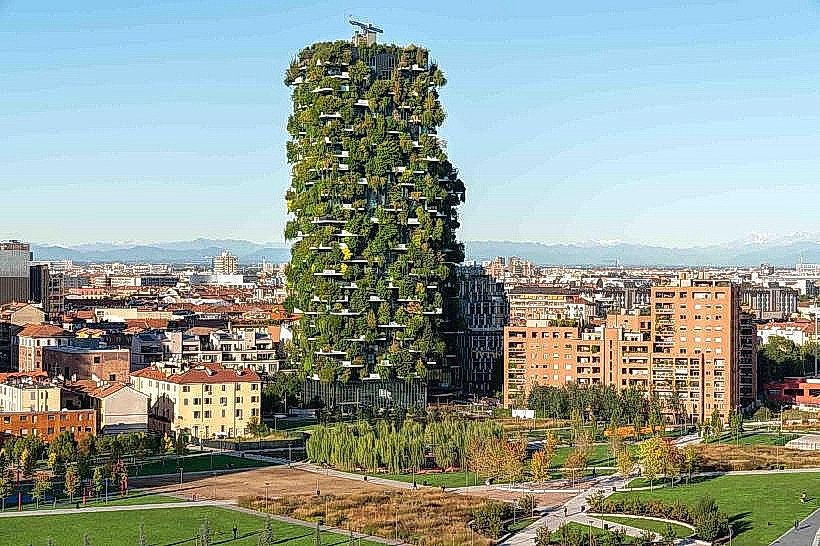
Bosco Verticale (Vertical Forest) – Two residential towers by Stefano Boeri covered in over 900 trees and 2,000 plants, visible from the square’s northern edge.
Torre Solaria, Torre Aria, and Torre Diamante – Sleek residential and business towers that complete the vertical panorama.
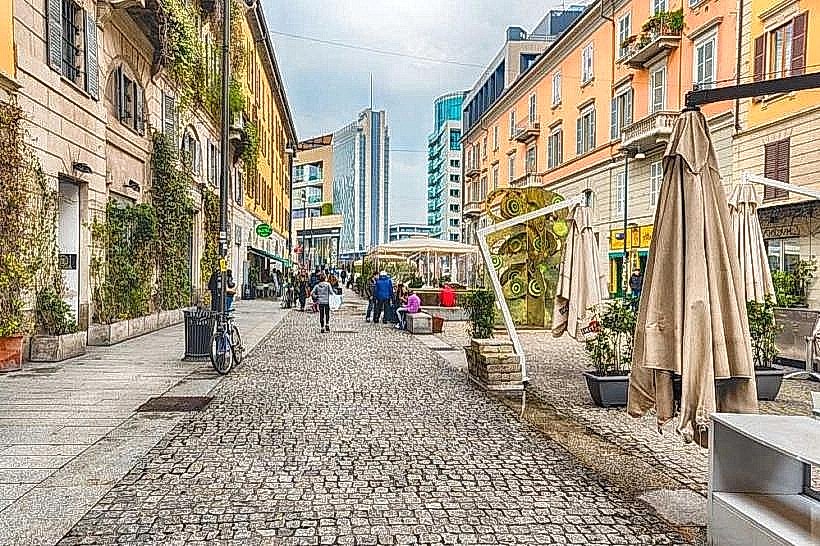
Corso Como and Porta Garibaldi – Historic and commercial streets that connect seamlessly to the new district, linking Milan’s tradition and innovation.
This juxtaposition of steel towers, green terraces, and historic brick buildings encapsulates the city’s layered identity-where the medieval and the futuristic coexist within sight of each other.
Urban Experience and Atmosphere
By day, Piazza Gae Aulenti feels like an open-air observatory of Milan’s modern life. Office workers cross the plaza with morning espresso in hand, tourists photograph the reflections in the fountain, and locals sit on the steps overlooking the Biblioteca degli Alberi park below. The air hums with conversation and the soft rhythm of water and footsteps.
At dusk, the transformation is striking. The glass façades glow gold, then silver-blue; LED lights trace the edges of the buildings; and the fountain dances to synchronized light patterns. Street performers often play violins or jazz near the edges of the circle, their music echoing softly between the towers.
On weekends, the square hosts public events, design festivals, and open-air installations, reflecting Milan’s role as a hub of art and design. Despite its futuristic setting, the square maintains a distinctly Milanese sensibility-elegant, orderly, and human in scale.
Symbolism and Design Philosophy
Piazza Gae Aulenti was conceived not merely as an architectural landmark, but as a symbol of Milan’s rebirth in the 21st century. After decades defined by industrial decline and postwar stagnation, the city reinvented itself around innovation, sustainability, and culture.
Its circular shape signifies continuity and inclusivity-a gathering place open to all, free from the hierarchy often imposed by monumental urban design. The elevated position physically separates it from car traffic, emphasizing pedestrian life and environmental balance. Solar panels, energy-efficient systems, and the integration of green roofs and terraces reinforce its sustainable vision.
Nearby Attractions and Connectivity
From Piazza Gae Aulenti, visitors can easily explore the surrounding modern district:
Biblioteca degli Alberi (Library of Trees) – A large urban park with thematic gardens and walking trails just below the square.
Corso Como 10 – A renowned concept store and gallery blending fashion, art, and design.
Eataly Smeraldo – A gourmet food hall celebrating Italian cuisine and regional specialties.
Porta Garibaldi Station – A key transport hub linking Milan with other major Italian and European cities.
The area also connects via pedestrian bridges to Isola, one of Milan’s most creative neighborhoods, where cafés, boutiques, and art spaces occupy converted industrial buildings.
Legacy and Contemporary Identity
Today, Piazza Gae Aulenti is more than just a landmark-it is Milan’s declaration of its place among Europe’s most progressive cities. Where once stood railyards and factories, there now rises a district that unites architecture, ecology, and human life.
It embodies the Milanese mindset: pragmatic yet visionary, elegant yet understated. From the reflections on its water surface to the silhouettes of towers against the sky, every detail speaks of a city that honors its past while confidently embracing its future.
Standing in the piazza at twilight-when lights shimmer across glass and water-it’s easy to feel the essence of modern Milan condensed into a single moment: ambition, artistry, and quiet sophistication, all perfectly balanced.