Information
Landmark: Castello di AciCity: Catania
Country: Italy
Continent: Europe
Castello di Aci, Catania, Italy, Europe
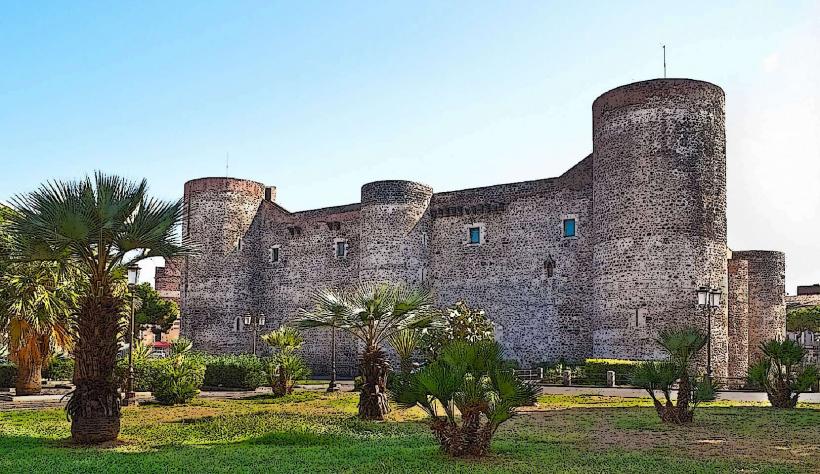
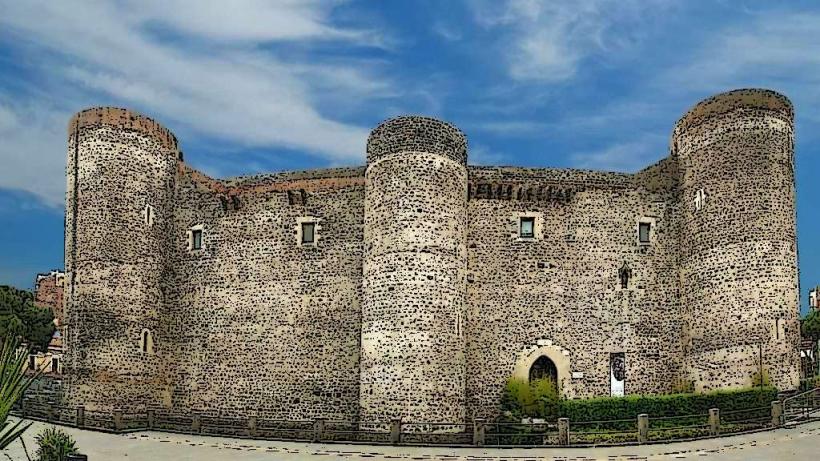
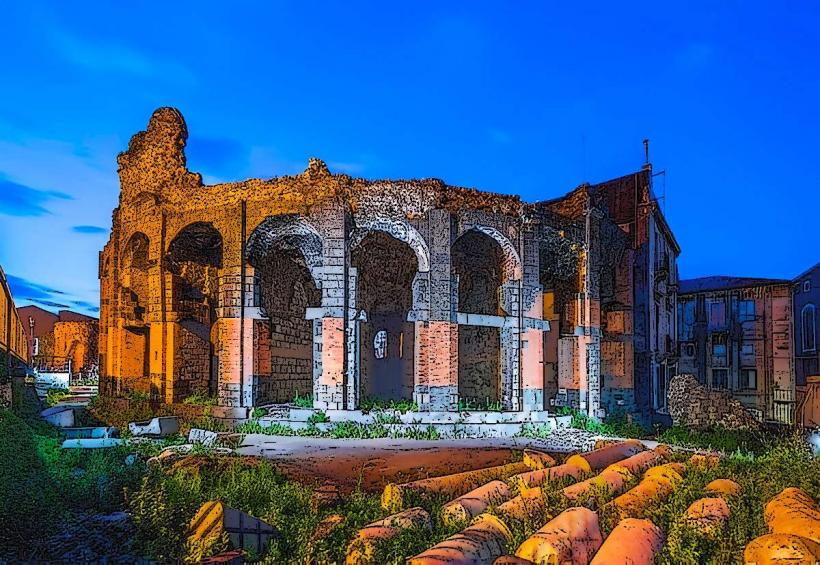
Castello di Aci (Norman Castle of Aci Castello) is a medieval fortification situated on a volcanic promontory in Aci Castello, 9 kilometers north of Catania. It is a primary landmark of the "Cyclops Coast" and serves as a civic museum.
Visual Characteristics
The castle is a "dark" fortress, constructed almost entirely from black basaltic lava stone. It sits atop a sheer 20-meter cliff of columnar basalt, which was formed by submarine volcanic activity. The architecture is characterized by its irregular plan, following the contours of the rock, with high crenellated walls, a central keep (donjon), and a small terrace offering panoramic views of the Ionian Sea and the Faraglioni of Aci Trezza.
Location & Access Logistics
The castle is located in Piazza Castello in the center of Aci Castello.
Transport: Accessible from Catania via AMTS bus line 534 or the regional train (to Aci Castello station, followed by a 15-minute walk).
Entry: Requires a paid ticket for the museum and terrace.
Accessibility: The site is characterized by steep, narrow stone stairs and uneven surfaces; it is not fully accessible to individuals with significant mobility impairments.
Historical & Ecological Origin
The site was a Roman fortification (Castrum Jacobi) before being developed by the Byzantines. The current structure is primarily Norman, rebuilt by Tancred of Hauteville in 1076. In 1169, a massive eruption and earthquake bridged the gap between the volcanic island (on which the castle sat) and the mainland. The fortress played a strategic role during the Sicilian Vespers and was later used as a prison and barracks.
Key Highlights & Activities
Civic Museum: Houses an archaeological collection featuring prehistoric remains, Greco-Roman artifacts, and a mineralogical section focused on Etna's volcanic products.
Botanical Garden: A small collection of Mediterranean succulents and cacti is maintained on the castle terraces.
The Keep: The highest point of the fortress, providing strategic views of the coastline.
Submarine Volcanism: The rock beneath the castle is a rare example of "pillows" and basaltic columns formed under the sea.
Infrastructure & Amenities
The museum includes a ticket office and basic restroom facilities. 4G/5G signals are excellent on the terraces but obstructed within the basalt halls. The surrounding piazza is a vibrant hub with cafes, restaurants, and public benches.
Best Time to Visit
Late afternoon is optimal for photography, as the setting sun illuminates the dark lava stone and the surrounding sea. The castle is a popular destination during the summer, but winter visits offer a clearer view of Mount Etna in the background without the coastal haze.
Facts & Legends
According to legend, the castle was one of the sites where the shepherd Aci and the sea-nymph Galatea met, before Aci was killed by the Cyclops Polyphemus. A verified historical fact is that in the 17th century, the castle was so well-fortified that it successfully resisted numerous pirate raids from the Maghreb.
Nearby Landmarks
Aci Trezza (Faraglioni): 2km North
Catania City Center: 9km South
Acireale: 7km North
Cyclops Isles Marine Protected Area: 1km East (Offshore)