Information
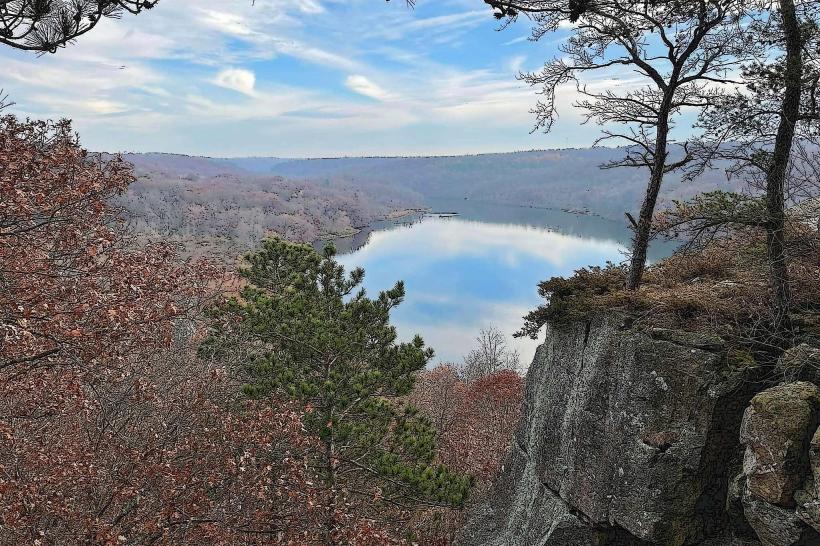
Landmark: Devil`s Lake State ParkCity: Madison WI
Country: USA Wisconsin
Continent: North America
Devil`s Lake State Park, Madison WI, USA Wisconsin, North America
The Empty Sky Memorial is a memorial dedicated to the victims of the September 11th attacks, located in Liberty State Park, Jersey City, New Jersey.
Visual Characteristics
The memorial consists of two 30-foot-tall walls of polished stainless steel, oriented towards the former World Trade Center site. The names of the 749 victims from New Jersey are inscribed on the walls. The memorial is situated on a granite base and is surrounded by a grassy area.
Location & Access Logistics
The Empty Sky Memorial is located within Liberty State Park at 1 Audrey Zapp Drive, Jersey City, NJ 07305. Access to the park is via the New Jersey Turnpike Extension (I-78 East) or Route 440. Parking is available within Liberty State Park, with fees typically applied during peak seasons. The PATH train stops at Exchange Place or Newport in Jersey City, requiring a bus or taxi to reach the park. NJ Transit bus routes 1, 6, 80, 81, 82, 84, 123, and 125 serve the Jersey City area, with connections to Liberty State Park.
Historical & Ecological Origin
The memorial was designed by the architectural firm Mandl & Shaffer and dedicated on September 11, 2011, the tenth anniversary of the attacks. It was conceived to honor the New Jersey residents who perished in the World Trade Center, the Pentagon, and on Flight 93.
Key Highlights & Activities
Visitors can walk between the two steel walls, reading the inscribed names. The memorial is a site for reflection and remembrance. The surrounding park offers walking paths and views of the Manhattan skyline.
Infrastructure & Amenities
Restrooms are available within Liberty State Park. Shade is provided by trees in the surrounding park areas. Cell phone signal (4G/5G) is generally available. Food vendors are typically present within Liberty State Park, particularly during warmer months.
Best Time to Visit
For optimal lighting on the polished steel, early morning or late afternoon provides softer reflections. The memorial is accessible year-round during Liberty State Park's operating hours. Weather is most favorable for outdoor visits between April and October.
Facts & Legends
The orientation of the walls is precisely aligned to face the exact location where the Twin Towers once stood. The polished stainless steel is designed to reflect the sky, symbolizing the "empty sky" left by the absence of the towers.
Nearby Landmarks
- Liberty Science Center (0.8km West)
- Central Railroad of New Jersey Terminal (1.2km Southwest)
- Ellis Island (2.5km East, across water)
- Statue of Liberty (3.0km East, across water)
- Colgate Clock (2.0km North)