Information
Landmark: Discovery MuseumCity: Newcastle
Country: United Kingdom
Continent: Europe
Discovery Museum, Newcastle, United Kingdom, Europe
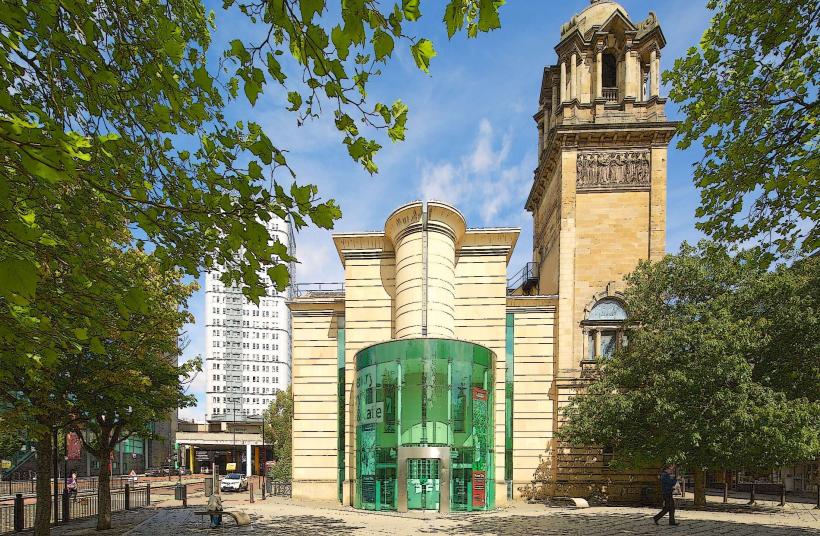
Discovery Museum is a science and local history museum located in the West End of Newcastle upon Tyne, United Kingdom. It is housed in Blandford House, a massive red-brick Victorian building that formerly served as the regional headquarters for the Co-operative Wholesale Society.
Visual Characteristics
The building is a prime example of Victorian industrial architecture, featuring a decorative brick facade, large arched windows, and a grand central staircase. The interior is defined by vast, high-ceilinged galleries. The focal point of the museum is the Turbinia, a 32-meter long steam-powered vessel housed in a purpose-built glass-fronted gallery at the entrance.
Location & Access Logistics
The museum is located at Blandford Square (NE1 4JA).
Public Transport: Newcastle Central Station (National Rail and Metro) is 0.4km east. St James' Metro Station is 0.5km north.
Road: Accessible via St James’ Boulevard.
Parking: Limited pay-and-display parking is available directly outside the museum in Blandford Square. The nearest multi-storey is Grainger Town Car Park.
Access: Fully accessible with ramps at the entrance and lifts serving all three floors.
Historical & Ecological Origin
The museum was established in 1934 as the Municipal Museum of Science and Industry, originally located in Exhibition Park. It moved to Blandford House in 1978 and was rebranded as the Discovery Museum in 1993. The collection documents the North East's pivotal role in the Industrial Revolution, specifically in shipbuilding, coal mining, and electrical engineering.
Key Highlights & Activities
Turbinia: The first ship to be powered by a steam turbine; once the fastest ship in the world (reaching 34.5 knots in 1897).
Newcastle Story: A permanent exhibition tracing the city's history from the Roman period to the late 20th century.
Science Maze: An interactive gallery featuring large-scale physics and engineering exhibits.
A History of Tyneside: Focuses on the social and maritime history of the River Tyne.
Play + Learn: A dedicated area for early years education and sensory play.
Infrastructure & Amenities
The facility includes the Turbinia Café on the second floor and a museum shop on the ground floor. Accessible restrooms and baby-changing facilities are located on all levels. 5G cellular signal is strong. The museum offers free Wi-Fi and a dedicated picnic area for schools and families.
Best Time to Visit
Open daily 10:00–16:00 (weekdays) and 11:00–16:00 (weekends). Entry is free. To avoid high-density school groups, visit after 14:00 on weekdays. The museum is a high-value destination during inclement weather due to its scale and indoor capacity.
Facts & Legends
A verified historical oddity is the collection of Joseph Swan's early lightbulbs; Swan, a Newcastle resident, demonstrated the first working incandescent lightbulb in the city in 1879, a year before Thomas Edison. The museum also houses one of the largest collections of Charles Algernon Parsons' original turbine components.
Nearby Landmarks
St James' Park (Newcastle United FC): 0.5km North
Life Science Centre: 0.3km Southeast
Newcastle Central Station: 0.4km East
The Blackfriars: 0.6km Northeast
China Town (Stowell Street): 0.6km North