Information
Landmark: Grotte di CastellanaCity: Bari
Country: Italy
Continent: Europe
Grotte di Castellana, Bari, Italy, Europe
The Grotte di Castellana is a major karstic cave system located in the Itria Valley, approximately 40 km southeast of Bari. It is one of Italy's most important and visited natural attractions, featuring a subterranean network extending over 3,000 meters.
Visual Characteristics
The caves are characterized by spectacular limestone formations, including massive stalactites, stalagmites, curtains, and columns. The color palette shifts from deep ochre and red (due to iron minerals) to brilliant white and translucent crystal. The journey concludes at the White Cave (Grotta Bianca), widely considered one of the brightest and most pristine alabaster caves in the world.
Location & Access Logistics
Located on the outskirts of the town of Castellana Grotte.
From Bari: Accessible via the Ferrovie del Sud Est (FSE) trains or buses (approx. 1 hour).
By Car: 45 minutes via the SS16 and SP237.
Tours: Access is strictly by guided tour only. Two options are available:
Short Tour: 1 km, approx. 50 minutes (excludes the White Cave).
Full Tour: 3 km, approx. 2 hours (includes the White Cave).
Conditions: The internal temperature remains constant at 16.5°C (62°F) year-round with 90% humidity. Rubber-soled shoes are required due to slippery surfaces.
Geological & Discovery Origin
The cave system began forming approximately 90 million years ago through the erosion of limestone by ancient underground rivers. The main entrance, a 60-meter-deep vertical shaft known as La Grave, remained known to locals for centuries (used as a waste pit). The scientific discovery and exploration of the entire system were conducted in 1938 by speleologist Franco Anelli.
Key Highlights
La Grave: The first and largest cavern, featuring a natural skylight in the ceiling that creates shifting pillars of light. It contains the "Cyclops" and "Hercules" stalagmites.
The Desert: A long, barren stretch of the cave that leads toward the more ornate sections.
The Altar: A formation resembling a religious altar, surrounded by "curtains" of stone.
The White Cave: The final chamber of the long tour, famous for its absolute whiteness and the delicacy of its crystalline formations.
Infrastructure & Amenities
5G/4G signals do not penetrate the caves; connectivity is lost once inside the descent. The surface area features a large visitor complex including a Speleological Museum, ticket office, cafes, souvenir shops, and ample parking. The site is partially accessible: the first cavern (La Grave) is accessible via elevator for those with mobility issues, but the full 3 km tour involves stairs and uneven terrain.
Best Time to Visit
The caves are open year-round. Because they are underground, they are an ideal destination during extreme summer heat or rainy weather. Pre-booking tickets online is highly recommended, especially for the Full Tour in English, as group sizes are limited.
Facts & Legends
For centuries, locals believed La Grave was an entrance to Hell because of the vapors (mist) rising from the hole and the smell of decomposing waste thrown inside. Since its discovery, the caves have been used as filming locations for various sci-fi and fantasy productions due to their "alien" landscape.
Nearby Landmarks
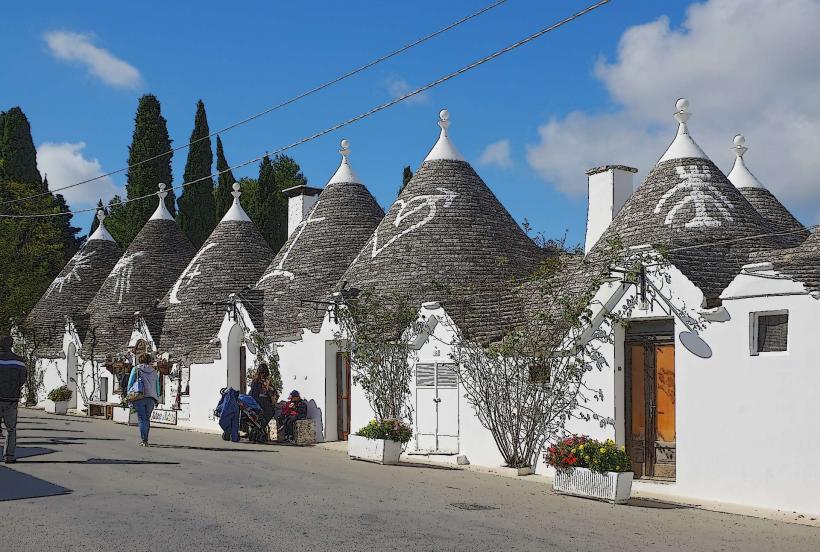
Alberobello: 15 km Southeast (Trulli houses).
Polignano a Mare: 17 km Northeast (Coastal cliffs).
Monopoli: 18 km East (Historic port).
Bari: 40 km Northwest.