Information
Landmark: Harding IcefieldCity: Seward
Country: USA Alaska
Continent: North America
Harding Icefield, Seward, USA Alaska, North America
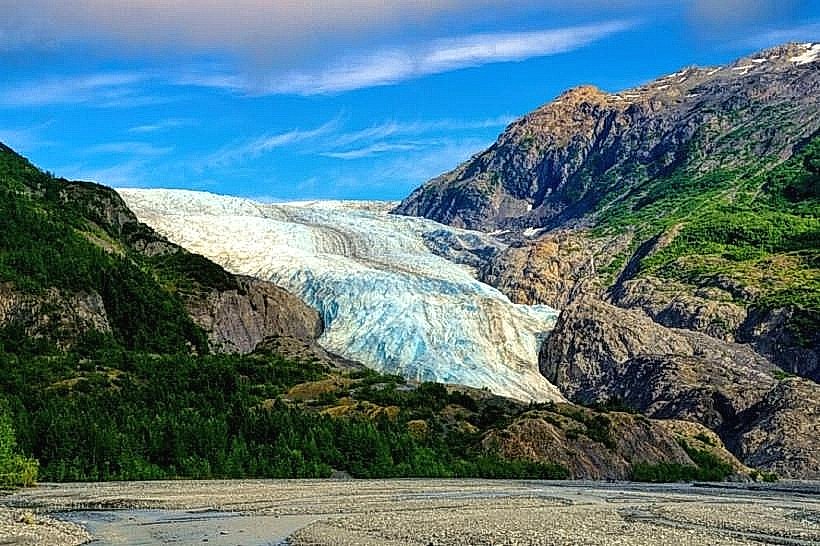
The Harding Icefield is one of Alaska’s most majestic natural wonders-an immense, shimmering expanse of ancient ice that stretches across nearly 700 square miles of the Kenai Mountains on the Kenai Peninsula. It is the icy heart of Kenai Fjords National Park, feeding more than thirty glaciers that flow outward in all directions, including the famous Exit Glacier near Seward. This vast field of ice feels like another world-an untouched, frozen ocean where mountains rise like dark islands through a sea of white.
A Landscape Born of Ice
The Harding Icefield formed during the Pleistocene epoch, thousands of years ago, when repeated glaciations sculpted the region’s fjords, valleys, and rugged peaks. What remains today is one of the largest icefields in the United States and one of the few that still exists largely in its natural, undeveloped state. Its thickness reaches hundreds of meters in some places, with compressed ice layers dating back centuries. Standing on its edge, it’s easy to imagine the slow, relentless work of time that shaped Alaska’s southern coast.
The Hike to the Icefield
The main access point for visitors is the Harding Icefield Trail, starting near the Exit Glacier Nature Center. This strenuous but unforgettable trek climbs about 1,000 meters (3,500 feet) over 4.1 miles, cutting through several distinct ecological zones-from temperate forest at the base to alpine tundra and bare rock near the summit.
Early on, the trail passes through cottonwood and alder thickets, where bears are sometimes spotted foraging for berries. Midway up, the air thins and the views open toward the valley below, where Exit Glacier snakes through the green landscape. Near the top, the vegetation disappears altogether, replaced by wind-swept ridges and snow patches that linger even in summer.
At the overlook, the world transforms. Before you lies a horizon of white-miles upon miles of snow and ice stretching beyond sight. The silence is immense, broken only by gusts of wind and the distant cracking of ice shifting beneath its own weight.
Life at the Edge of Ice
Despite its harshness, the Icefield supports surprising bursts of life around its margins. Mountain goats often pick their way across rocky slopes, and hardy lichens cling to exposed stone. In summer, meltwater from the icefield feeds rivers teeming with salmon, drawing black bears and bald eagles to the lower valleys. Scientists studying the Harding Icefield use it as a barometer of climate change, tracking subtle shifts in its mass and the retreat of its outlet glaciers year after year.
Visiting and Weather
The best time to visit is late June through early September, when the trail is generally clear of snow and the skies occasionally open to reveal the icefield in full sunlight. Even in midsummer, temperatures near the top can drop below freezing, and weather can shift from calm to stormy within minutes. Many hikers carry layers, trekking poles, and crampons if venturing farther across snowfields.
Winter transforms the entire region into a vast, silent wilderness. While the access road is closed, experienced backcountry skiers and mountaineers sometimes make multi-day expeditions onto the ice, camping amid endless white silence.
Closing Impression
The Harding Icefield is less a destination than a revelation. Reaching its edge feels like standing at the threshold of deep time-a reminder of how small human presence is against the patience of ice. The experience is humbling, exhilarating, and unforgettable: the pure stillness of Alaska’s frozen crown, shimmering under a cold, brilliant sun.