Information
Landmark: Katmai National Park & PreserveCity: Seward
Country: USA Alaska
Continent: North America
Katmai National Park & Preserve, Seward, USA Alaska, North America
Katmai National Park and Preserve, located on Alaska’s remote southwestern coast, is a land shaped by fire, water, and time-an extraordinary wilderness where volcanoes still breathe, rivers pulse with salmon, and brown bears dominate the landscape. Spanning over four million acres, Katmai is one of the most dynamic and untamed corners of Alaska, celebrated for its raw volcanic scenery and its unparalleled opportunities to observe bears in the wild.
Landscape and Origins
Katmai’s story begins in 1912, when the Novarupta Volcano erupted with cataclysmic force-one of the most powerful eruptions of the 20th century. The explosion blanketed the region in ash and reshaped entire valleys, giving birth to the Valley of Ten Thousand Smokes, a vast, otherworldly expanse where steam once rose from thousands of fissures in the newly formed ash fields. That eruption and its aftermath prompted the creation of the Katmai National Monument in 1918, later expanded into today’s National Park and Preserve.
The park’s terrain remains astonishingly varied: glacier-carved mountains, tundra plains, forested rivers, and volcanic peaks still active beneath the surface. Over a dozen volcanoes lie within its borders, seven of them still considered active. Lakes like Naknek and Brooks sparkle amid this rugged setting, providing the freshwater lifelines that sustain both wildlife and human exploration.
The Bears of Katmai
Katmai is most famous for its brown bears, often considered the densest population anywhere on Earth. Each summer, hundreds of bears gather to feed on salmon migrating upstream through the park’s rivers. Nowhere is this spectacle more iconic than at Brooks Falls, where bears stand shoulder-deep in rushing water, catching leaping salmon midair.
From the wooden viewing platforms near Brooks Camp, visitors can watch these massive animals-some exceeding half a ton-engage in a primal dance of survival, yet often with moments of surprising gentleness. The bears’ behavior here has become so well documented that many individuals, like “Otis” and “Grazer,” are known by name, drawing enthusiasts from around the world through live-streamed “bear cams” and annual “Fat Bear Week” celebrations.
Human History and Research
Before the eruption that remade the landscape, the region was home to the Alutiiq (Sugpiaq) people, who lived off its rich coastal and inland resources for thousands of years. Archaeological evidence near Brooks River shows more than 4,000 years of continuous human habitation. Today, these sites are carefully protected, offering rare insight into the long relationship between people and Alaska’s shifting environments.
Katmai is also a living field laboratory. Scientists study everything from volcanic geology to salmon ecology and predator-prey dynamics. The park’s remote wilderness offers one of the clearest pictures of how large ecosystems function when left almost entirely undisturbed.
Visiting Katmai
Access to Katmai is part of its mystique-there are no roads leading in. Travelers reach the park primarily by floatplane or boat from hubs such as King Salmon or Homer. The most visited area, Brooks Camp, offers lodgings, campgrounds, ranger programs, and trails, including hikes to Brooks Falls and the Valley of Ten Thousand Smokes Overlook. Beyond this area, Katmai is pure wilderness, reachable only by charter aircraft or guided expedition.
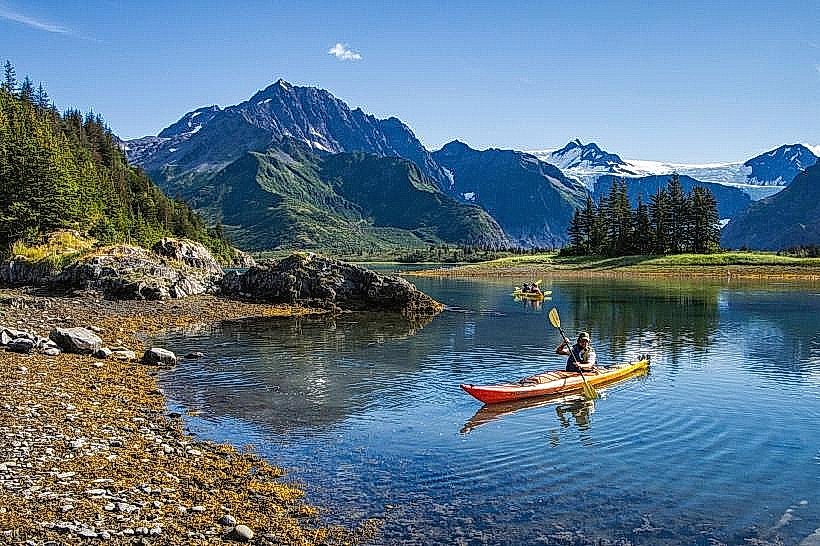
Kayakers explore the shores of Naknek Lake, while backcountry adventurers traverse tundra valleys and volcanic plateaus. Every journey here demands self-sufficiency, respect for wildlife, and a readiness for unpredictable weather-Katmai’s storms can be fierce, and fog often rolls in without warning.
Atmosphere and Seasons
In summer, the landscape bursts with life: bears fishing in clear rivers, salmon running red against turquoise water, and meadows of wildflowers under a midnight sun. Autumn paints the tundra in amber and crimson, while bears fatten for hibernation. Winter descends in silence, sealing the lakes with ice and snow, leaving only the wind and the distant rumble of the earth below.
Closing Impression
Katmai National Park & Preserve is Alaska at its most elemental-a meeting of fire and life, chaos and renewal. Standing at Brooks Falls or gazing over the Valley of Ten Thousand Smokes, you feel both humbled and exhilarated. It is a landscape still forming, still alive, where the wild heart of Alaska beats most freely.