Information
Landmark: Regensburg Stone BridgeCity: Regensburg
Country: Germany
Continent: Europe
Regensburg Stone Bridge, Regensburg, Germany, Europe
The Stone Bridge (Steinerne Brücke) in Regensburg, Germany, is a remarkable medieval structure that spans the Danube River. It is one of the most iconic landmarks in the city and a key example of medieval engineering. The bridge is not only an important historical monument but also a testament to the architectural and engineering prowess of the time.
Key Features of the Stone Bridge
Historical Background
- The Stone Bridge was constructed between 1135 and 1146 under the direction of the Archbishop of Regensburg, Arnold of Schwarzach. It replaced an earlier wooden bridge and was intended to provide a more permanent and reliable crossing over the Danube, facilitating trade, travel, and communication between the various parts of the Holy Roman Empire.
- The bridge played a crucial role in connecting the north and south of Europe, linking the trading routes of the Mediterranean with those of Central Europe. Its strategic location made it one of the most important medieval crossings in the region.
- It remained the only bridge across the Danube in Regensburg for over 700 years, until the completion of the Walhalla Bridge in the 19th century.
Architectural Design
- The Stone Bridge is 16 arches long and stretches about 310 meters (1,017 feet) across the river. The bridge is built of sandstone, sourced from local quarries, and its construction was an impressive feat for its time, especially given the challenging conditions of building over a major river.
- The design of the bridge is simple yet effective, with a series of pointed arches that distribute the weight and allow the structure to span the river without needing extensive support in the water.
- The bridge’s design incorporates spires and gothic elements, which were added during later renovations, making it a blend of Romanesque and Gothic styles.
Engineering and Construction
- The construction of the bridge was an enormous task and involved innovative engineering techniques for its time. Scaffolding and stone-lifting techniques were used to transport and position the massive stones, and the construction was overseen by master builders who were experts in medieval bridge-building techniques.
- The arches were built in a semi-circular fashion, which is typical of Romanesque architecture, designed to distribute the load evenly across the bridge. The work was completed in around 11 years, a relatively quick timeframe for such an ambitious project.
Strategic Importance
- The Stone Bridge was of immense strategic and economic importance. It connected the Roman Catholic bishopric of Regensburg with the rest of Europe, enabling the city to become a major center for commerce, religion, and culture in the Middle Ages.
- During the height of its use, the bridge was a major trade route, facilitating the movement of goods like salt, grain, and wine across the Danube, as well as providing a critical route for pilgrims traveling to religious sites.
Cultural Significance
- The Stone Bridge has become a symbol of Regensburg itself, and it holds significant cultural value for the city. It is one of the best-preserved medieval bridges in Europe and has been included in several historical and architectural surveys.
- In the 19th century, the Stone Bridge was partially restored to preserve its structure and appearance, and it has continued to serve as a major crossing point over the Danube.
- The bridge is featured in many local legends and folk tales, reflecting its importance to the city's identity.
Modern-Day Use
- While the Stone Bridge no longer serves as the main traffic route across the Danube (modern bridges now handle the bulk of vehicular traffic), it remains an important pedestrian bridge, drawing visitors from around the world.
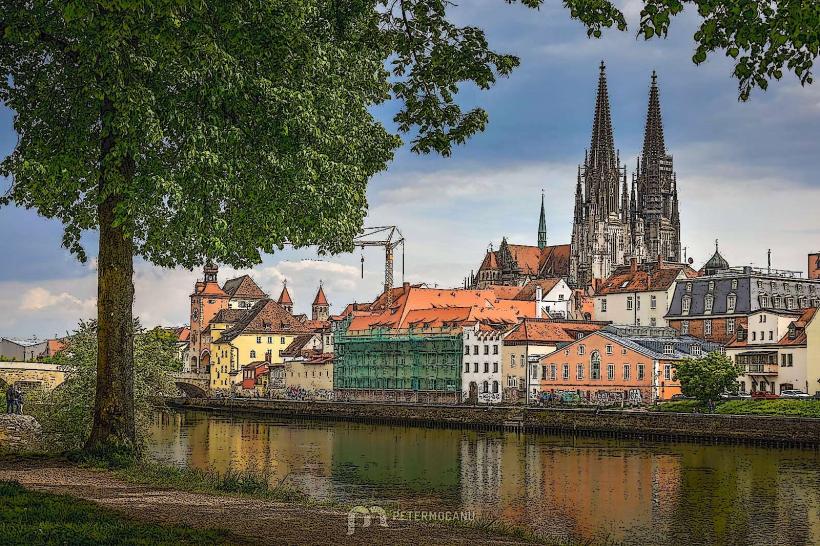
- The bridge offers spectacular views of the city’s skyline, including the Regensburg Cathedral and the Old Town, both of which are UNESCO World Heritage Sites. Visitors often walk across the bridge to enjoy the scenic vistas of the Danube River and the surrounding area.
Preservation and Protection
- Over the centuries, the Stone Bridge has undergone several restorations to ensure its stability and longevity. In the 20th century, efforts were made to preserve its medieval character while adapting it to modern needs, such as the reinforcement of the arches and repairs to the stonework.
- Today, the bridge is protected as a historical monument, and it is regularly maintained by the city of Regensburg to prevent further deterioration and to ensure that it continues to be a safe and accessible landmark for both locals and visitors.
Tourism and Visitor Experience
- The Stone Bridge is one of Regensburg’s most popular tourist attractions, and visitors often stop to admire its historical and architectural significance.
- The bridge provides a direct path from the Old Town to the Würzburg Gate and other key points in the city, making it a great starting point for exploring Regensburg’s historical heart.
- The views from the bridge are breathtaking, especially at sunset, when the light reflects off the river and highlights the medieval architecture of the city.
Legend of the Bridge
- Local legends surrounding the Stone Bridge have contributed to its mystique. One such story is that the construction of the bridge was completed with the help of a devil. According to the legend, the builders made a pact with the devil, and in exchange for his assistance in completing the bridge, they agreed to give him the first soul that crossed. However, clever townspeople outwitted the devil, sending a dog across first instead of a human.
Conclusion
The Stone Bridge of Regensburg is more than just an architectural marvel; it is a symbol of the city’s rich medieval heritage. The bridge’s construction in the 12th century helped shape the development of Regensburg, making it an important hub for trade, religion, and culture in the Holy Roman Empire. Today, it stands as a well-preserved and beloved landmark, attracting visitors from around the world who come to appreciate its history, its stunning views of the city and the Danube River, and its contribution to the architectural heritage of Germany.