Information
Landmark: Strumica FortressCity: Strumica
Country: North Macedonia
Continent: Europe
Strumica Fortress, Strumica, North Macedonia, Europe
The Strumica Fortress is a medieval fortification located on a hill overlooking the city of Strumica in southeastern North Macedonia.
Visual Characteristics
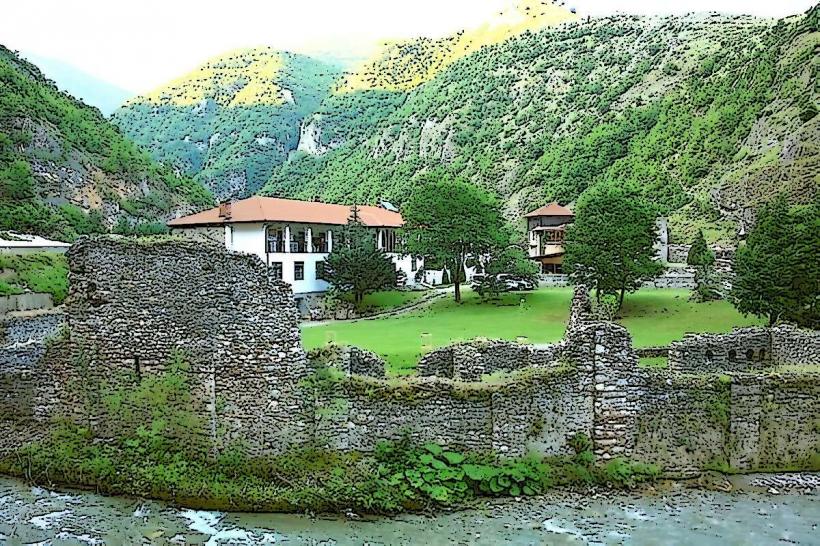
The fortress consists primarily of stone remnants, including sections of defensive walls and foundations of former towers. The construction material is local grey stone, weathered over centuries. The remaining structures vary in height, with some wall sections reaching several meters. The architectural style reflects typical medieval Byzantine and Ottoman military engineering, characterized by robust, unadorned stone masonry designed for defense rather specific aesthetic.
Location & Access Logistics
The fortress is situated on a prominent hill immediately north of the Strumica city center. Access is typically via local paved roads that ascend the hill from the city. From the main city square, the fortress is approximately 1.5 kilometers north. Limited parking is available at the base of the hill or in designated areas within the city, requiring a short uphill walk to the ruins. Public transport within Strumica is limited to local taxis; there are no specific bus lines directly serving the fortress site.
Historical & Ecological Origin
The original construction of the Strumica Fortress is attributed to the 5th-6th century during the Byzantine era, with significant reconstructions and expansions occurring in the 11th-14th centuries under various rulers, including the Byzantines, Bulgarians, and Serbs. Its primary purpose was a strategic defensive stronghold, controlling the vital Strumica valley and trade routes. The fortress was later utilized and modified by the Ottoman Empire.
Key Highlights & Activities
Visitors can explore the remaining stone walls and foundations of the fortress, offering a tangible connection to its long history. The elevated position provides panoramic views of the city of Strumica, the surrounding agricultural plains, and distant mountains. Self-guided exploration of the ruins is the primary activity.
Infrastructure & Amenities
There are no dedicated restrooms or permanent shade structures directly at the fortress ruins. Cell phone signal (4G/5G) is generally strong due to the site's proximity to the city. Food vendors and other amenities are available in the city center of Strumica, approximately 1.5 kilometers away.
Best Time to Visit
The best time to visit for photography is during the early morning or late afternoon to capture softer light and avoid harsh shadows. The most favorable months for weather are April, May, September, and October, when temperatures are mild. Summer months can be very hot, and winter can be cold and potentially snowy.
Facts & Legends
The Strumica Fortress has been destroyed and rebuilt numerous times throughout its existence, reflecting its critical strategic importance in the region. It served as a key defensive point for various empires, including the Byzantine, Bulgarian, Serbian, and Ottoman, each leaving its mark on the structure's evolution and eventual decline.
Nearby Landmarks
- Strumica City Museum: 0.5km South-East
- Strumica City Park: 0.5km South
- St. Cyril and Methodius Church: 0.8km South-East
- St. Leontius Monastery (Vodoča): 3km West