Information
Landmark: Algar do CarvaoCity: Azores
Country: Portugal
Continent: Europe
Algar do Carvao, Azores, Portugal, Europe
Algar do Carvão is a rare volcanic chimney and lava tube located in the center of Terceira Island. It is one of the few places in the world where visitors can enter the interior of a volcano and observe the intact conduit that once channeled magma to the surface.
Visual Characteristics
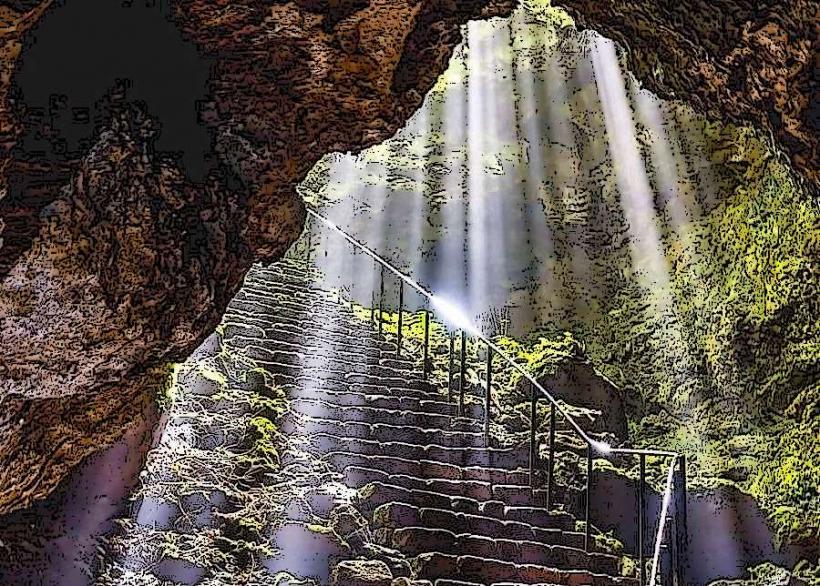
The site is a vertical cavern reaching a depth of approximately $90$ meters. The interior walls are covered in moss and ferns near the entrance, where sunlight penetrates. Deep within the chimney, the walls are composed of dark basalt and unique "silica stalactites"-white, glassy formations created by hydrothermal activity. A crystal-clear lake of rainwater sits at the bottom, which can reach depths of $15$ meters during the winter season.
Location & Access Logistics
The cave is situated within the Guilherme Moniz Caldera, approximately 12 kilometers north of Angra do Heroísmo. Access is via the EN5-2A highway. There is a paved parking area at the visitor center. Entrance is controlled and requires a ticket, often sold as a combined pass with the Gruta do Natal lava tube. Public transport is non-existent; access requires a rental car, taxi, or organized tour.
Historical & Ecological Origin
The chimney was formed during two distinct volcanic events: the first approximately 3,200 years ago and the second 2,000 years ago. Unlike most volcanic vents that collapse after an eruption, the conduit at Algar do Carvão remained open. It was first explored in 1893 by Cândido do Rego Quinta, but regular descents did not begin until 1963. It is a designated Regional Natural Monument and a key site within the Azores UNESCO Global Geopark.
Key Highlights & Activities
The main activity is a self-guided walk down a series of concrete stairs and tunnels into the main cavern. Highlights include the Catedral (Cathedral), a massive chamber with impressive acoustic properties, and the silica formations that are unique to this specific volcanic structure. The site provides a rare perspective on the internal plumbing of a monogenetic volcanic field.
Infrastructure & Amenities
A modern visitor center serves as the entrance, containing a small exhibition area, a gift shop, and public restrooms. 5G cellular signal is available at the surface but is completely lost once inside the volcanic chimney. The descent involves over $300$ steps; consequently, it is not wheelchair accessible. Waterproof clothing is recommended as water constantly drips from the ceiling.
Best Time to Visit
The cave is typically open only in the afternoons (14:30 to 17:30), with expanded hours during the summer months. To avoid large tour groups, arrival at the opening time or shortly before closing is optimal. Photography is challenging due to low light and high humidity; a tripod or a camera with high ISO capability is necessary to capture the scale of the interior.
Facts & Legends
Local legends long held that the pit was bottomless or led to the center of the earth. Geologically, the silica stalactites found here are among the purest in the world. A verified fact is that the water level in the bottom lake is entirely dependent on seasonal rainfall; in exceptionally dry summers, the lake can disappear completely, revealing the rocky floor.
Nearby Landmarks
Gruta do Natal (Christmas Cave): 4.5km West
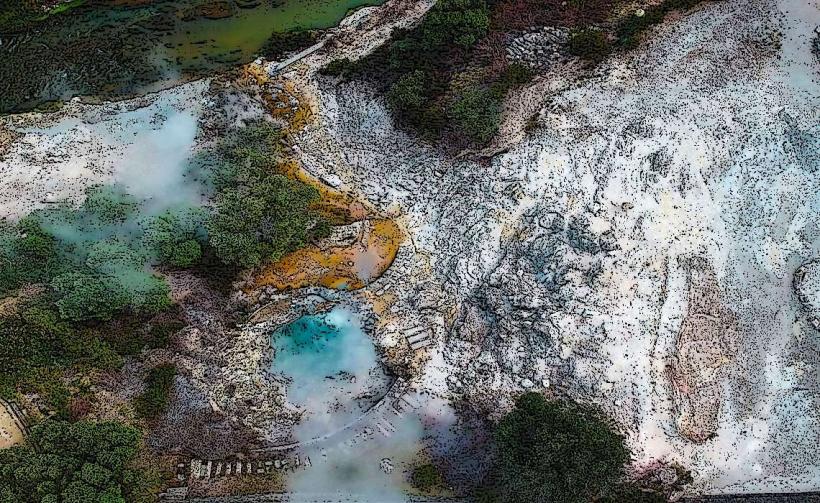
Furnas do Enxofre (Sulfur Caverns): 1.8km Northwest
Monte Brasil: 13.5km South
Biscoitos Natural Pools: 11.0km North
Serra do Cume Viewpoint: 10.5km East