Information
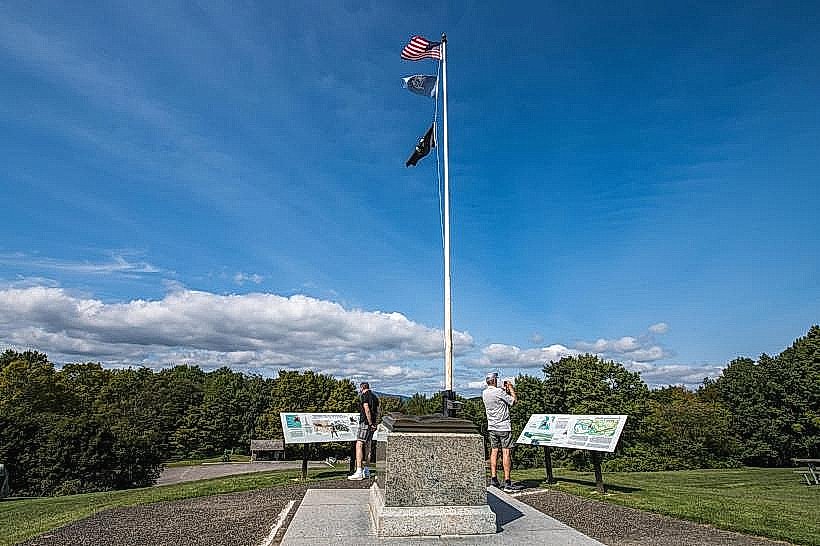
Landmark: Bennington Battle MonumentCity: Bennington
Country: USA Vermont
Continent: North America
Bennington Battle Monument, Bennington, USA Vermont, North America
Guinguette Forest is a protected natural area located on the outskirts of Bobo Dioulasso, Burkina Faso.
Visual Characteristics
The forest is characterized by dense deciduous trees, primarily species adapted to the Sahelian climate. The ground cover consists of dry grasses and scattered shrubs. A small, seasonal stream, the Houet River, flows through the western section, its water color varying from muddy brown during the dry season to a clearer, darker hue after rainfall. Rock outcrops are present in the northern sector.
Location & Access Logistics
Guinguette Forest is situated approximately 8 kilometers southwest of Bobo Dioulasso's city center. Access is via the Route Nationale 1 (RN1) towards Bobo-Dioulasso Airport, then turning onto a dirt track marked by local signage. The track is approximately 2 kilometers long and is generally passable for 2WD vehicles during the dry season. During the rainy season (June-September), a 4WD vehicle is recommended. There is no designated parking area; vehicles are typically parked along the track's edge. Public transport does not directly serve the forest; visitors usually arrange private transport or taxis from Bobo Dioulasso.
Historical & Ecological Origin
Guinguette Forest is classified as a classified forest, established by administrative decree in the mid-20th century to protect local biodiversity and prevent desertification. Ecologically, it represents a transition zone between Sudanian savanna and Sahelian vegetation. The area is part of a larger watershed system feeding into the Houet River.
Key Highlights & Activities
Walking and birdwatching are the primary activities. The forest supports a variety of bird species, including several migratory types during certain periods. Observing local flora and fauna is possible. Visitors can follow informal trails within the forest.
Infrastructure & Amenities
There are no formal infrastructure or amenities within Guinguette Forest. Restrooms, shade, and food vendors are not available. Cell phone signal (2G/3G) is intermittent and unreliable within the forest itself, though it may be present on the main road leading to the access track.
Best Time to Visit
The best time for visiting is during the dry season, from November to April, when the vegetation is less dense and the ground is easier to traverse. The early morning hours (6:00 AM - 9:00 AM) offer optimal lighting for photography and increased wildlife activity. The late afternoon (4:00 PM - 6:00 PM) also provides good light.
Facts & Legends
Local folklore suggests that certain ancient trees within the forest possess protective spirits. It is a common practice for individuals seeking good fortune or protection to leave small offerings at the base of these specific trees, though the exact locations are not publicly marked.
Nearby Landmarks
- Bobo-Dioulasso Airport (0.8km Northeast)
- Grande Mosquée de Bobo-Dioulasso (6.5km Northeast)
- Musée Honoré de Balzac (7.2km Northeast)
- Parc National de la Comoé (Access point approximately 45km Southwest, but the park itself is much larger)