Information
Landmark: Laufas Turf HousesCity: Akureyri
Country: Iceland
Continent: Europe
Laufas Turf Houses, Akureyri, Iceland, Europe
Laufas Turf Houses are a preserved historical farmstead located on the east bank of the Eyjafjörður fjord, approximately 23 kilometers north of Akureyri, Iceland. This site functions as a museum, showcasing traditional Icelandic turf house architecture and 19th-century rural life.
Visual Characteristics
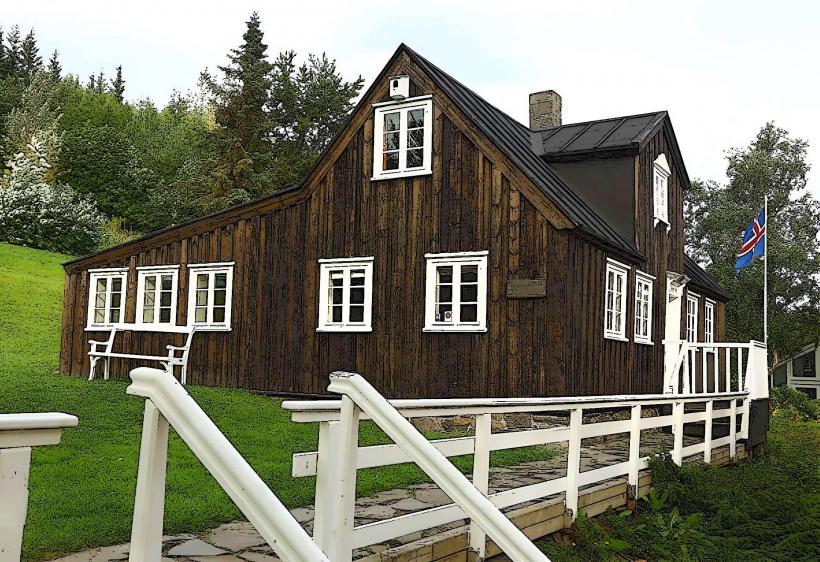
The farmstead comprises several interconnected turf houses, characterized by thick turf walls and roofs covered in grass, giving them a low-profile, organic appearance that blends with the landscape. The structures feature timber gables and doorways, often painted in dark colors such as black or dark brown. The turf roofs are typically green, varying in shade with the seasons. Individual houses are relatively small, with low ceilings and narrow passages, reflecting the construction methods and living conditions of the period. The complex includes a church, a smithy, and various living and storage spaces.
Location & Access Logistics
Laufas Turf Houses are situated off Road 83, which branches east from Route 1 (the Ring Road) north of Akureyri. From Akureyri city center, drive north on Route 1 for approximately 15 kilometers, then turn right onto Road 83 and continue for another 8 kilometers. The site is clearly signposted. Ample free parking is available directly at the entrance. Public transport options are limited; a rental car or organized tour is the most practical method of access. There are no specific bus lines serving the immediate area directly from Akureyri.
Historical & Ecological Origin
The current structures at Laufas date primarily from 1865 to 1877, though a church has stood on this site since the 11th century, and a parsonage since the 14th century. The farmstead served as a parsonage and a large farm, housing the priest, his family, and numerous farmhands. The construction utilizes a traditional Icelandic method involving a timber frame, often driftwood, covered with layers of turf and stone. This design provided excellent insulation against the harsh Icelandic climate. The site was acquired by the National Museum of Iceland in 1948 and opened as a museum in 1957.
Key Highlights & Activities
Visitors can walk through the interconnected turf houses, exploring the various rooms including the kitchen, pantry, living quarters, and sleeping areas. The interiors are furnished with authentic 19th-century artifacts, tools, and household items. Guided tours are available during opening hours, providing detailed historical context. The small Laufas Church, dating from 1865, is also accessible. A short walking path leads around the farmstead, offering views of the Eyjafjörður fjord.
Infrastructure & Amenities
Modern restrooms are available on-site, located near the entrance and visitor center. Limited natural shade is provided by the low-lying buildings and a few trees, but the site is largely exposed. Cell phone signal (4G) is generally reliable throughout the area. A small café and gift shop are located in the visitor center, offering light refreshments, souvenirs, and local crafts. Drinking water is available.
Best Time to Visit
The best time to visit Laufas Turf Houses is during the summer months, from June to August, when the weather is mildest and the turf roofs are at their greenest. The museum is typically open from May to September. For photography, late morning or early afternoon provides optimal lighting, illuminating the front of the houses without harsh shadows. The site is not significantly affected by tides.
Facts & Legends
Laufas was one of the wealthiest parsonages in Iceland, supporting a large community. The last priest to reside here, Reverend Björn Halldórsson, lived in the turf house until 1936. A unique feature of the Laufas complex is the "baðstofa," a communal living and sleeping room, which was heated by body warmth and often used for handicrafts and storytelling during long winter nights. It is said that the turf houses were designed to be easily expanded or modified by adding new sections, much like organic growth.
Nearby Landmarks
- Grenivík (village) - 3km North
- Grenivíkurkirkja (Grenivík Church) - 3.2km North
- Eyjafjörður fjord (natural feature) - 0.1km West