Information
Landmark: Praskvica MonasteryCity: Budva
Country: Montenegro
Continent: Europe
Praskvica Monastery, Budva, Montenegro, Europe
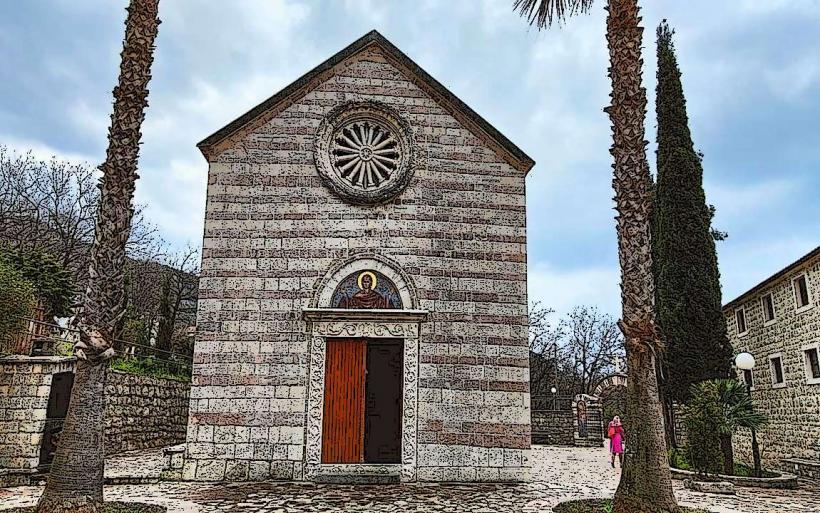
Praskvica Monastery (Manastir Praskvica) is a Serbian Orthodox complex located on a hill above Miločer and Sveti Stefan. Founded in 1050, it serves as the spiritual and cultural center of the Paštrovići tribe.
Visual Characteristics
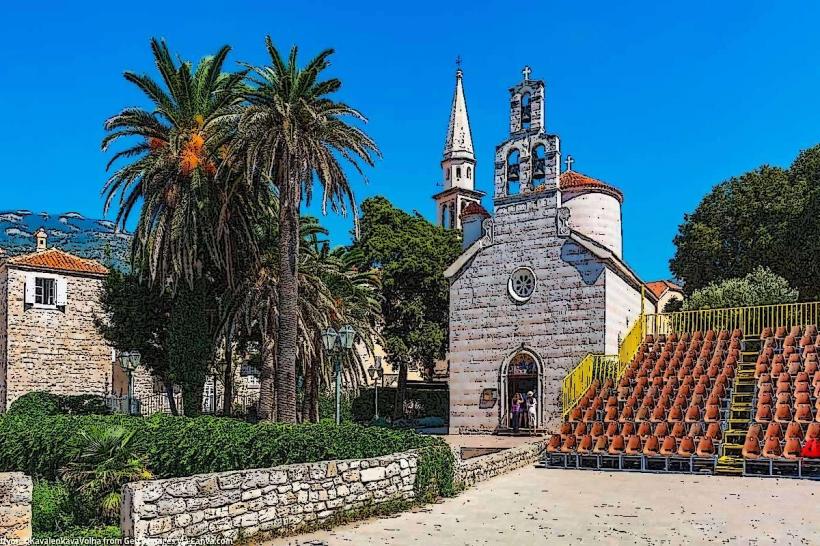
The complex contains two churches: the smaller Church of the Holy Trinity (17th century) and the larger Church of Nicholas the Wonderworker (rebuilt in 1847). The architecture is characterized by rustic stone masonry and a traditional Mediterranean belfry. The interior of the Church of St. Nicholas contains a grand iconostasis by the Greek master Nicholas Aspioti. The monastery is surrounded by ancient olive groves and orchards.
Location & Access Logistics
The monastery is situated 7 km southeast of Budva, overlooking the Adriatic Highway.
Access: Reachable via a steep, winding road from the main highway or by a historic stone staircase (the "Jelena Štiljanović Path") leading up from the coast at Miločer.
Parking: Small, free parking area available at the monastery entrance.
Entry: Free admission. Standard religious dress codes apply (shoulders and knees covered).
Historical & Political Origin
The monastery's name derives from the local word praskva (peach), referring to a nearby spring that reportedly tasted of peaches. It was a vital political hub for the Paštrovići "Bankada" (tribal court). The original 11th-century church was destroyed by French Napoleonic troops in 1812 in retaliation for the tribe's resistance. The current main church was rebuilt with financial aid from Russia in the mid-19th century.
Key Highlights & Activities
The Treasury: One of the most significant in Montenegro, containing the "Golden Gospel" (a gift from Russian Tsar Alexander I), medieval manuscripts, and a silver cross belonging to the Nemanjić dynasty.
The Library: Houses over 5,000 volumes and historical archives of the Paštrovići region.
The Stone Table: A historic meeting place where the tribal assembly made administrative and judicial decisions.
Infrastructure & Amenities
The monastery remains an active brotherhood. A small shop sells monastic products, including olive oil and honey. 4G/5G cellular coverage is functional but can be intermittent due to the terrain. Public restrooms are available for visitors.
Best Time to Visit
The site is best visited in the morning for optimal lighting on the facade and a quieter atmosphere. The panoramic view of Sveti Stefan from the monastery gardens is a primary photographic highlight in the late afternoon.
Facts & Legends
A famous legend associated with the monastery is that of Jegor Stroganov, a one-armed Russian monk who spent ten years in the late 18th century building a 3-kilometer stone path from the sea to the monastery in total silence as a form of penance. His identity remained a mystery until his death.
Nearby Landmarks
Sveti Stefan: 1km Southwest
Miločer Park (King’s Beach): 0.8km West
Reževići Monastery: 4km Southeast
Budva Old Town: 7.5km Northwest