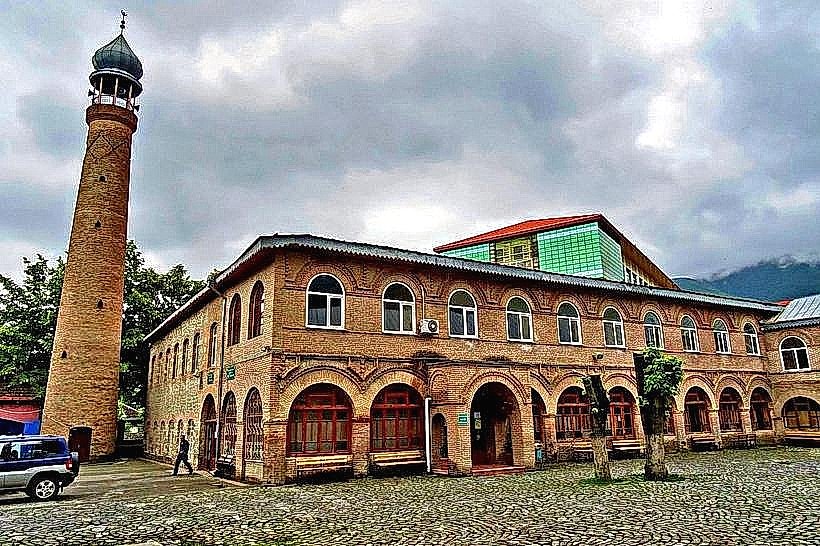
Information
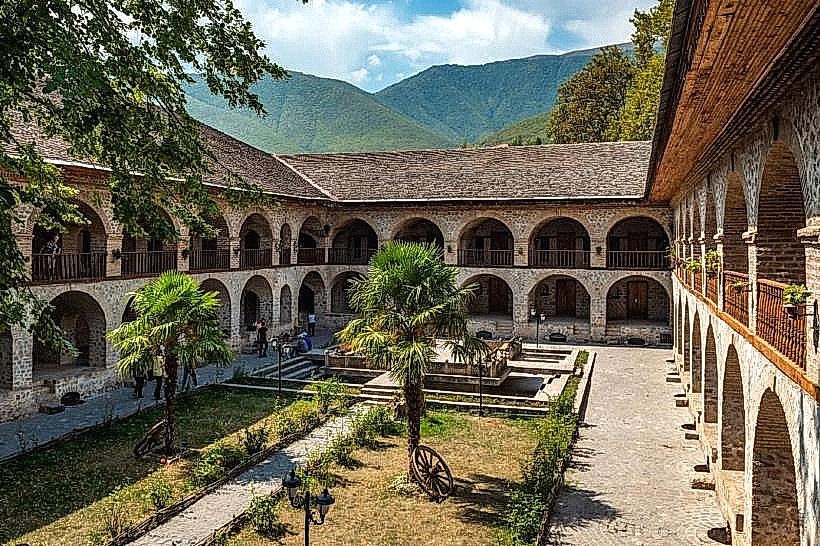
Landmark: Sheki Khan’s PalaceCity: Sheki
Country: Azerbaijan
Continent: Asia
Sheki Khan’s Palace, Sheki, Azerbaijan, Asia
The Nkongsamba Town Hall is a municipal administrative building located in the city of Nkongsamba, Littoral Region, Cameroon.
Visual Characteristics
The structure is a two-story building constructed primarily of concrete with a red-tiled pitched roof. The facade features a central entrance with a prominent arched doorway, flanked by rectangular windows on both levels. The exterior walls are painted a pale yellow, with white trim around the windows and roofline. A small clock tower, also with a red-tiled roof, is situated above the main entrance.
Location & Access Logistics
The Nkongsamba Town Hall is situated in the central district of Nkongsamba, approximately 0.8 kilometers (0.5 miles) south of the main market square. Access is via Rue de la Poste, a paved urban road. Limited on-street parking is available directly in front of the building. Public transport within Nkongsamba typically consists of shared taxis and motorcycle taxis, which can drop visitors at the town hall.
Historical & Ecological Origin
Construction of the Nkongsamba Town Hall was completed in 1952 during the French colonial administration. It was designed to serve as the administrative center for the growing town, housing municipal offices and council chambers. The building's architectural style reflects the functionalist approach common in colonial public works of the mid-20th century.
Key Highlights & Activities
The primary function of the Nkongsamba Town Hall is administrative. Visitors may access public services such as permit applications or civil registry. The building's exterior architecture can be observed from the street. No specific visitor activities are organized within the building itself.
Infrastructure & Amenities
Restrooms are available for public use within the building. Shade is provided by the building's roof and the surrounding trees on Rue de la Poste. Cell phone signal (4G) is generally reliable in this central urban area. Food vendors are present in the nearby market square, approximately 0.8 kilometers away.
Best Time to Visit
For administrative purposes, visiting during standard weekday business hours (approximately 08:00 to 15:00) is recommended. The best time of day for exterior photography is mid-morning or late afternoon when the sun angle provides clear illumination of the facade without harsh shadows. The dry season, from November to March, offers the most pleasant weather for travel to Nkongsamba.
Facts & Legends
A local anecdote suggests that the clock tower was intentionally designed to be slightly off-center to symbolize the ongoing adjustments and development of Nkongsamba as a regional hub.
Nearby Landmarks
- Nkongsamba Central Market: 0.8km North
- St. Joseph's Cathedral: 1.2km Northwest
- Nkongsamba Regional Hospital: 1.5km Southwest
- Camrail Station Nkongsamba: 2.1km East