Information
Landmark: Nockberge Biosphere ParkCity: Graz
Country: Austria
Continent: Europe
Nockberge Biosphere Park, Graz, Austria, Europe
The Nockberge Biosphere Park (UNESCO Biosphärenpark Salzburger Lungau & Kärntner Nockberge) is a protected mountain landscape located primarily in Carinthia, approximately 160 km (99 miles) southwest of Graz.
Visual Characteristics
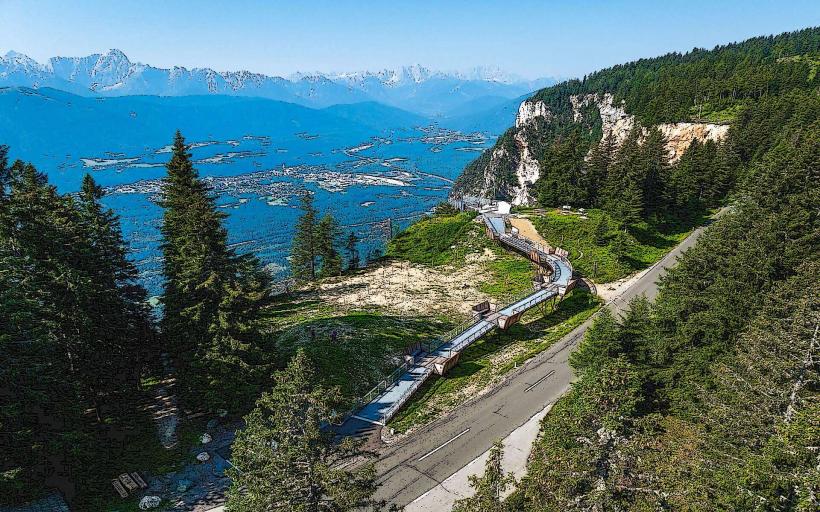
The park is distinguished by its unique geological formations called "Nocken"-ancient, rounded, grass-covered limestone peaks that contrast with the jagged, glaciated summits of the neighboring High Tauern. The landscape features rolling alpine meadows, deep larch and stone pine forests, and crystal-clear mountain lakes.
Location & Access Logistics
From Graz:
Vehicle: Approximately a 2-hour drive via the A2 (Süd Autobahn) toward Klagenfurt, then the S37 and B95 toward Ebene Reichenau.
Transit: Rail from Graz Hbf to Klagenfurt Hbf, then a regional bus (Postbus) toward Feldkirchen and Ebene Reichenau. Total transit time is roughly 3.5 to 4 hours.
Nockalm Road (Nockalmstraße): A 34-km scenic toll road with 52 hairpin bends that traverses the heart of the park between Innerkrems and Ebene Reichenau. It reaches an elevation of 2,042 meters.
Major Gateways: Bad Kleinkirchheim, Turracher Höhe, and Ebene Reichenau.
Historical & Ecological Origin
The Nockberge mountains are among the oldest geological formations in the Alps. The area was designated a National Park in 1987 following a 1980 referendum where 94% of the local population voted against large-scale ski resort development. In 2012, it was converted into a UNESCO Biosphere Reserve to better balance environmental protection with sustainable regional culture and economy.
Key Highlights & Activities
Nockberge Trail: A multi-day long-distance hiking route (approx. 125 km) that stays mostly above the tree line.
Silva Magica: An interactive nature trail near the Grundalm focusing on forest spirits and alpine ecology; it is fully barrier-free.
Speik (Valeriana celtica): The park is the only place in the world where this rare, aromatic alpine plant is harvested commercially for use in cosmetics.
Turracher Höhe: A high plateau with three lakes and the "Nocky Flitzer" alpine coaster.
Karlbad: A historic farmers' spa where thermal water is heated using hot stones in wooden troughs-a tradition dating back several centuries.
Infrastructure & Amenities
Nockmobil: A flexible, on-demand shuttle system that provides transit between hiking trailheads and villages for those without vehicles.
Gastronomy: Over 40 managed alpine huts (Hütten) serve regional specialties like Kärntner Kasnudeln (cheese noodles) and Reindling (yeast cake).
Connectivity: 4G/5G coverage is reliable in the main villages and along the Nockalm Road, though signal may be lost in deep valleys.
Best Time to Visit
June & July: For alpine rose blossoms and peak green meadows.
September & October: For the golden discoloration of the larch forests and the "Bauernherbst" festivals.
Winter: While the Nockalm Road is closed to cars, the region becomes a hub for "soft" winter sports like snowshoeing and ski touring.
Nearby Landmarks
Lake Millstatt (Millstätter See) – 25 km South
Bad Kleinkirchheim Thermal Spas – Located at the southern edge
Mölltal Glacier – 75 km West
Graz – 160 km East