Information
Landmark: Stade du 4 AoûtCity: Ouagadougou
Country: Burkina Faso
Continent: Africa
Stade du 4 Août, Ouagadougou, Burkina Faso, Africa
Stade du 4 Août is a multi-purpose stadium located in Ouagadougou, Burkina Faso. It serves as a primary venue for football (soccer) matches and athletics.
Visual Characteristics
The stadium features a rectangular playing field with a natural grass surface. It is surrounded by a standard athletics track. Seating is primarily concrete benches, with some covered sections. The structure is largely utilitarian, with exposed concrete elements and metal roofing over spectator areas.
Location & Access Logistics
Stade du 4 Août is situated in the central district of Ouagadougou. It is approximately 2 kilometers south of the city center. Access is via Avenue de l'Indépendance, which connects directly to the stadium complex. Ample parking is available within the stadium grounds. Public transport options include local bus lines that service Avenue de l'Indépendance, with stops within a 5-minute walk of the stadium.
Historical & Ecological Origin
The stadium was constructed in 1983 and inaugurated on August 4, 1984, hence its name. It was built to host national sporting events and serve as a training facility. Its origin is purely man-made, designed for athletic competition.
Key Highlights & Activities
The primary activity is attending football matches, particularly those involving the national team, the Stallions, or local clubs like Étoile Filante and RC Kadiogo. Athletics competitions are also held here. Limited public access for casual use is generally not permitted outside of scheduled events.
Infrastructure & Amenities
Restrooms are available within the stadium complex, though their condition can vary. Shade is provided by the roofing over some spectator sections. Cell phone signal (4G/5G) is generally reliable within the stadium vicinity. Food vendors are typically present during major events, selling local snacks and beverages.
Best Time to Visit
For football matches, the best time to visit is during the football season, typically from September to May. Match start times are usually in the late afternoon or early evening to avoid the peak heat. The dry season, from November to April, offers more predictable weather conditions.
Facts & Legends
The stadium's capacity has been subject to various estimates over the years, with figures ranging from 25,000 to 40,000 spectators. It has hosted significant international tournaments, including qualifiers for the Africa Cup of Nations.
Nearby Landmarks
- Musée National du Burkina Faso (0.8km North)
- Palais de la Culture et du Tourisme (1.2km North)
- Grand Marché (1.5km North)
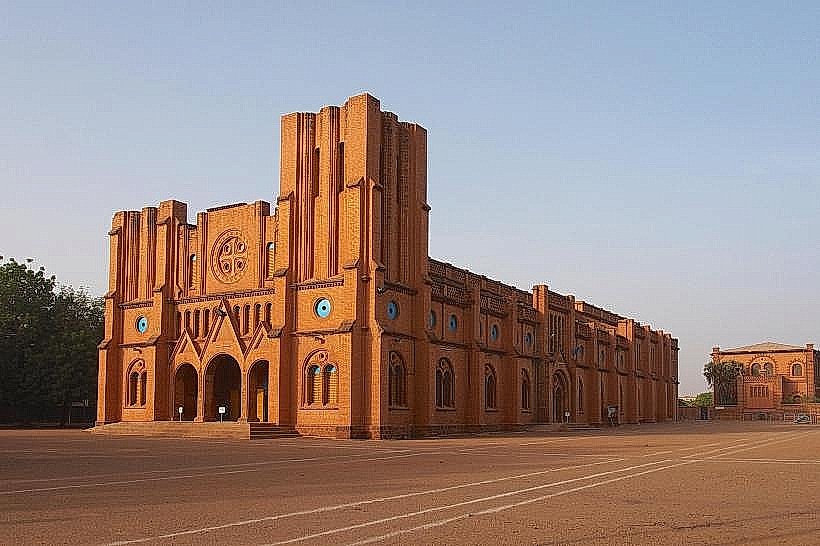
- Cathédrale de l'Immaculée Conception (1.8km North)