Information
Landmark: Cathedral of Our Lady of the ConceptionCity: Maputo
Country: Mozambique
Continent: Africa
Cathedral of Our Lady of the Conception, Maputo, Mozambique, Africa
The Cathedral of Our Lady of the Conception (Catedral de Nossa Senhora da Conceição) is one of Maputo’s most important religious and architectural landmarks, standing quietly yet prominently at Praça da Independência, the historic heart of the city. Unlike the ornate colonial churches found elsewhere, this cathedral is defined by restraint, clarity, and modernist purpose, reflecting a turning point in both architecture and Mozambican urban identity.
Historical Context
The cathedral was completed in 1944, during the later phase of Portuguese colonial rule, at a time when Maputo (then Lourenço Marques) was expanding beyond decorative historicism toward functional modern design. It replaced earlier religious structures and was intended to serve as the principal Catholic church of the city. Over the decades, the cathedral has witnessed key moments in Mozambique’s history, including independence in 1975 and major national ceremonies held in the surrounding square. Its presence at Independence Square places it at the symbolic crossroads of colonial legacy and national sovereignty.
Architectural Character
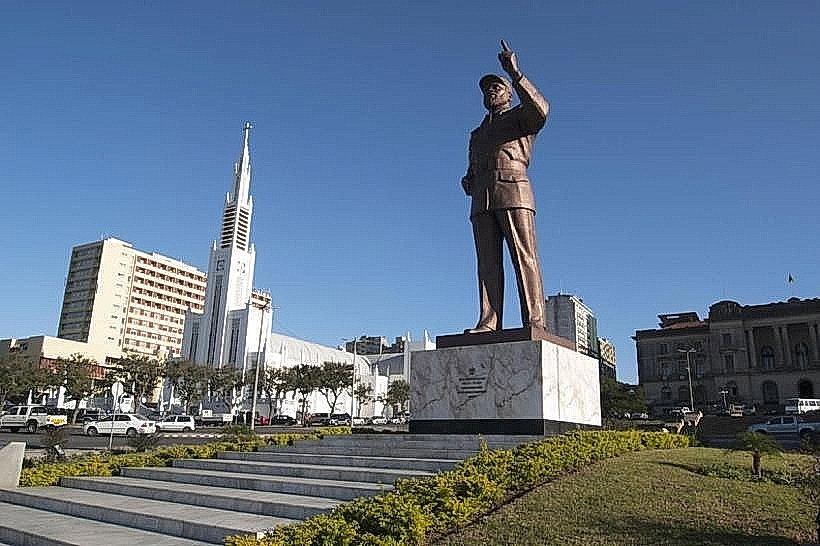
Architecturally, the cathedral is a notable example of modernist ecclesiastical design in Africa. It was designed with clean geometric lines, minimal ornamentation, and a strong vertical emphasis. The most striking feature is its tall, slender bell tower, rising sharply above the square and visible from several surrounding streets.
The exterior is defined by pale stone and smooth surfaces, intentionally free of heavy decoration. This simplicity gives the building a timeless quality and allows light and shadow to play across its façade throughout the day. The structure feels solid and calm, projecting stability rather than grandeur.
Interior Atmosphere
Inside, the cathedral continues its modernist language. The nave is spacious and uncluttered, with high ceilings and narrow vertical windows that filter in soft natural light. The absence of excessive ornament draws attention to proportion, silence, and the rhythm of the space. Wooden pews, modest religious artwork, and a restrained altar arrangement create an atmosphere that feels contemplative rather than theatrical.
During services, the acoustics amplify hymns and spoken prayer in a gentle, resonant way, giving the interior a sense of depth and quiet focus.
Religious and Community Role
As the seat of the Archdiocese of Maputo, the cathedral remains an active place of worship and a central institution for the city’s Catholic community. Regular masses, religious celebrations, and major liturgical events take place here, often drawing worshippers from across the city. On significant religious dates, the square outside fills with people, blending civic space with spiritual life. The cathedral also plays a role in moments of national remembrance and public reflection.
Urban Setting and Experience
The cathedral’s location enhances its impact. Facing Independence Square, it stands alongside major civic buildings and monuments, creating a dialogue between faith, governance, and history. Visitors often notice how the building feels different depending on the time of day: quiet and cool in the early morning, reflective at midday, and softly illuminated in the evening. Its simplicity invites a pause, whether one enters for prayer or simply observes it as part of the city’s everyday rhythm.
Cultural Significance
The Cathedral of Our Lady of the Conception represents a departure from colonial excess toward modern clarity. It embodies an architectural philosophy that values purpose, light, and calm, and it continues to function as both a spiritual anchor and an urban landmark. In Maputo’s diverse architectural landscape, the cathedral stands out not by ornament, but by quiet confidence and enduring presence.